|
I wanted to send this out to really set in stone my trading philosophy here on Daytradingradio.com, to review my methodology and to lay out for you the future plans of the site. To do this I have to go back to the beginning and the incarnation of DTR. Even though I have been trading actively since 1993, I have never traded for anyone other then myself and family. I saw trading as a path to living my dreams which at the time was pretty simple, live on a beach, fish and trade. I came from your average middle class suburban family where both parents worked. My mom as was a waitress and my father was a laborer. They wanted me to go to college, get a good job, work hard and retire with little to worry about. I tried to follow that path by going to college for a couple years with no direction. It wasn't even a college I got to go away to, it was more like summer school. Big drag I was gypped out of my college experience but then I got a job at the great United States Postal Service! As far as everyone was concerned I was set, Mother was happy and Father was proud. I had a secure job with great benefits and a pension when I retired.
There were about 25 people who worked at the post office and it seemed all of them were miserable. I just wanted to get through the day and go fishing. About five years in it hit me, how was I going to be able to work here for 30 years? I was surrounded by workers that had already been there for 25 years or more and they still had another 5 years to go in most cases. Here's where it gets depressing. Within the next year and a half 4 coworkers passed away due to some cancer or sickness. I was starting to see the value of time spent on this earth and a seed was planted in me. At that time I made my decision that I would not be at the post office for very long. This was not the path I wanted. At the same time I was really involved in Martial Arts and opened a school in my town. I was introduced by my teacher to one of his close friends and fellow instructors, Virgil. I ended up studying under him and becoming good friends. I came to find out that Virgil was a stock trader and I was fascinated that he could make money trading. That was the beginning of my new journey.
Now a journey has many paths and I decided mine was going to be one as a trader. There were a lot of pit falls and learning experiences along the way. But trading is a journey of self awareness and it would enable me to have the freedom I wanted. I would no longer have to spend the next 30 years wishing my day was over so I could get off of work. Trading is a battle to overcome shortcomings in all of us. Greed, confidence and discipline are the 3 hardest characteristics to master when trading. Trading is a solitary journey for the most part, as it is very rare to find someone who understands your dreams or dedication.
The markets are and will always be stacked against you. Why did I just come out and say that? Because human nature makes it that way. The markets are set up so that the majority loses and minority wins. Who is the minority? The novice trader and the thousands of traders that came before you and made the same mistakes over and over. These novice traders sell into support and buy into resistance and the smart traders profit from them. Who are the smart traders, the majority? The market makers and the specialists. They have consistently made money since the market was created. So why are they so successful?
They are successful because they trade opposite the crowd. They are always on the other side of the orders. When you buy, they are selling to you. When you sell, they are buying your shares. They know what you are going to do next. How? Because human psychology doesn't change.
I have a saying I say on the radio every so often "Money has Patience". This is the other main reason most traders lose money in the markets and one of the reasons I am writing this today. You have to be patient. I feel the lure of easy money in the markets is very overwhelming. But for most people they trade way over there risk tolerance and with too little capital. What I mean by too little capital is all relative. It's ok to trade with $5,000 ($10,000 margin) but it's not going to work out when you are buying 200-300 shares of a $30 dollar stock. You might think how am I going to make money just trading 30 -40 shares? Let me get to the point: you have to have realistic goals and a systematic approach to trading along with patience. Most of all you have to stick to those rules the best that you can. You can call that money management.
The market has many variables that can cause it to go up and down, these are brought to light mostly in the media where anyone basically can get on TV and make a market call. You see an analyst on one day with an upgrade and major buy call and three days later you see another come out on the opposite side of the call. Is there anyone you can trust in the markets? I think you know the answer to that. It's always been said that losing money is just part of being a successful trader. It is weird to see the word losing and successful in the same sentence but it is true. It is impossible to avoid losses while trading the market. It's hard to watch a stock move in the wrong direction of the desired trade. Emotions will run wild. The more money involved the more sweat you will loose.
So how do we prevent loosing money? By having a strict set of rules and mastering your inner discipline. Have a plan and stick to the plan as best as you can. Don't trade over your pain threshold. That last part "Pain Threshold" is most important to me and let me stress why, pain is the root of so many emotions, pain in trading might not be physical (but I think we all know it definitely could tear up your insides a bit). Pain is the mental anguish of losing more money then you planned to. If we can somehow control the root of the pain which = the amount of money, then the pain diminishes. TRADE WITH SMALLER AMOUNTS.
Now let's get up to date on what's been going on.
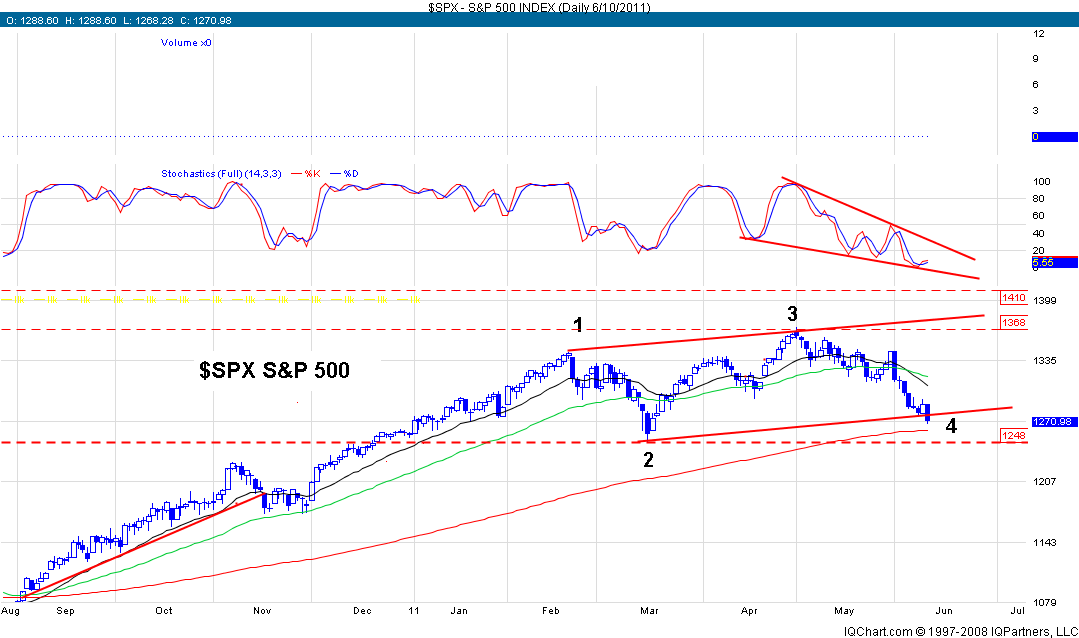
The market as of Friday has been in a quick 2 week pull back, overall sentiment has been extremely negative and stochastic are oversold both on the daily and on the 60 minute chart. We are on the lower channel line (possible breakdown on Friday). If I tell you I am convinced that we are going lower then I will fall right in line with the majority and we just discussed earlier that history has proven the majority wrong more often then right.
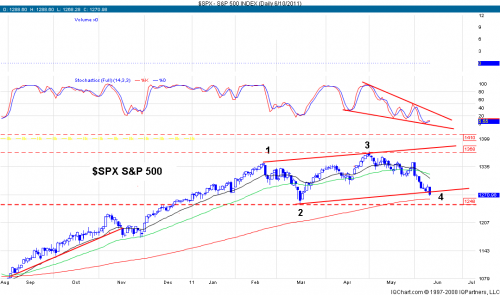
Something I recommend that can improve your trading is being on the right side of the trend. I have been asked by some people why I haven't initiated shorts in the last week or why I don't take more shorts in the market. The reversal on June 1st was unexpected for me and before that I had multiple shorts on the watch list. I was short LULU, MCO, EBAY, and ANF was called a short among others, along with RIMM. One thing for sure I needed to bring more shorts to the table even if I don't take them. I will do that in the future.
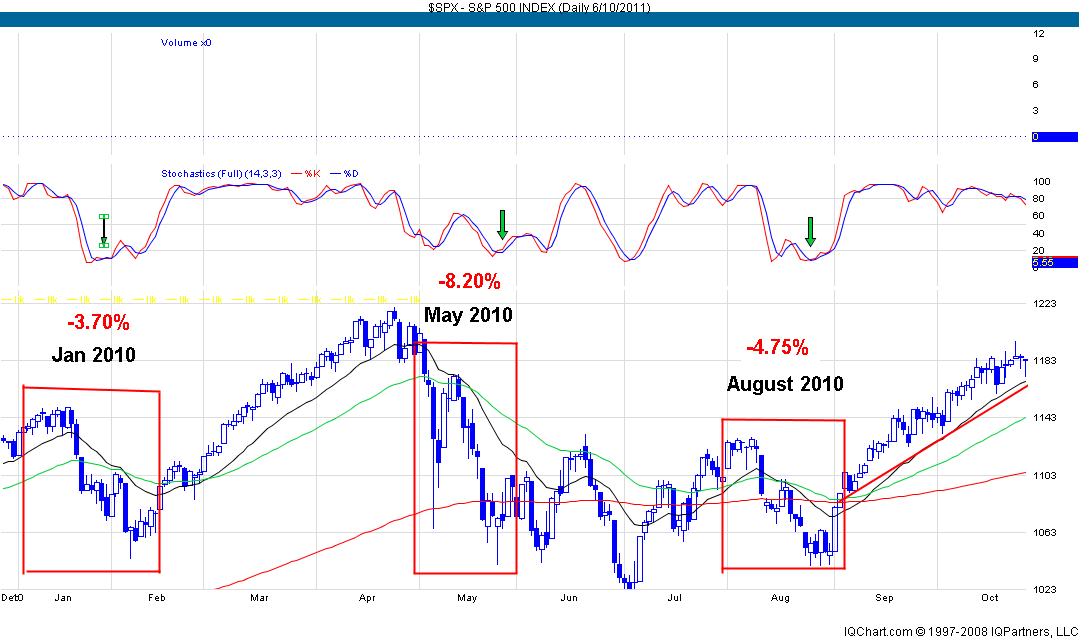
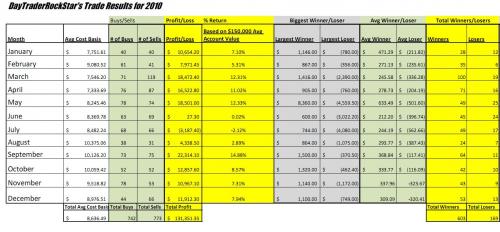
As we come into next week I will be scaling back on position size until there is a direction off this lower channel line. At the same time I will be sticking to my methodology trading High Probability Setups. I made my living buying quality stocks on pull backs. I had a question on Friday that if the market continues to drop does this methodology continues to be profitable? Well the toughest part of trading is the chop and the changing of the trend. If you can recognize this fast then it's game on. I want to have a trending market and if not I will cut back on my trading drastically. But back to the question, last year we defiantly had some pullbacks and some chop in June and July as shown below
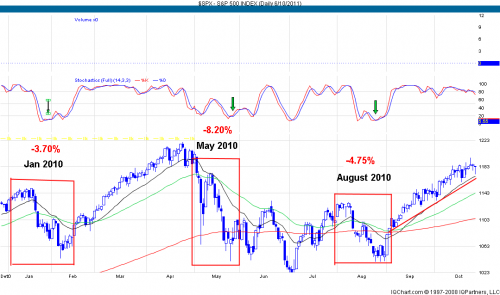
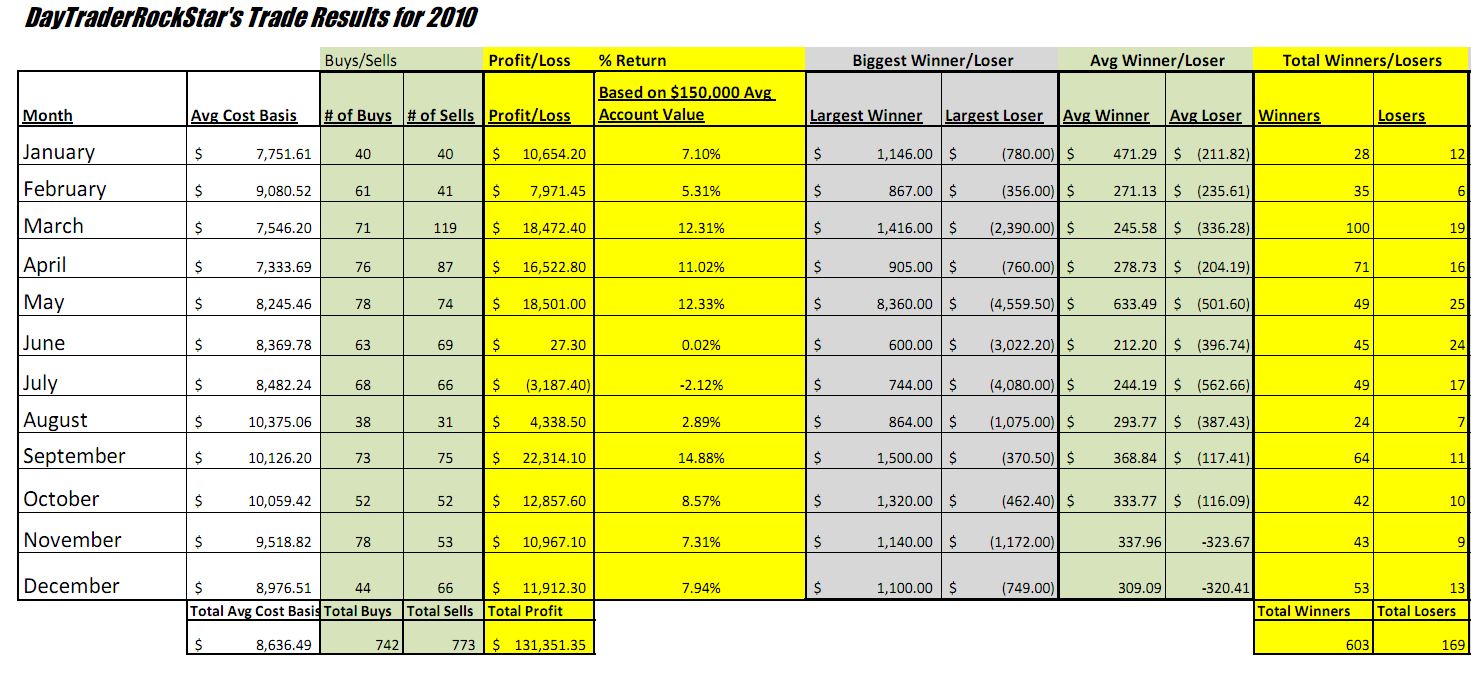
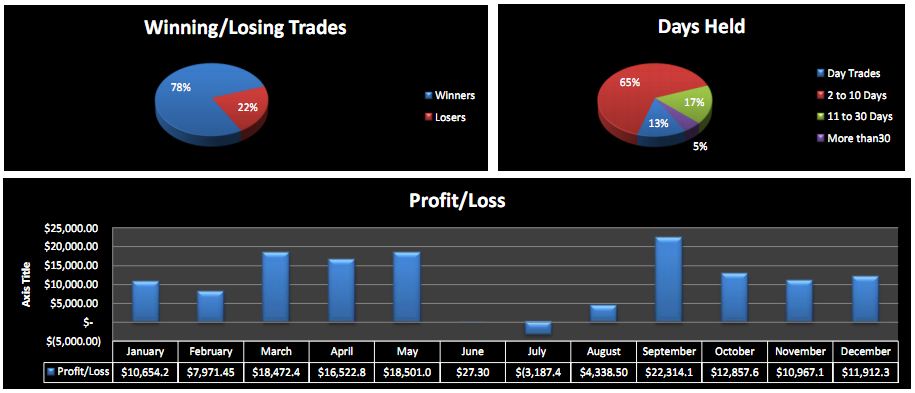
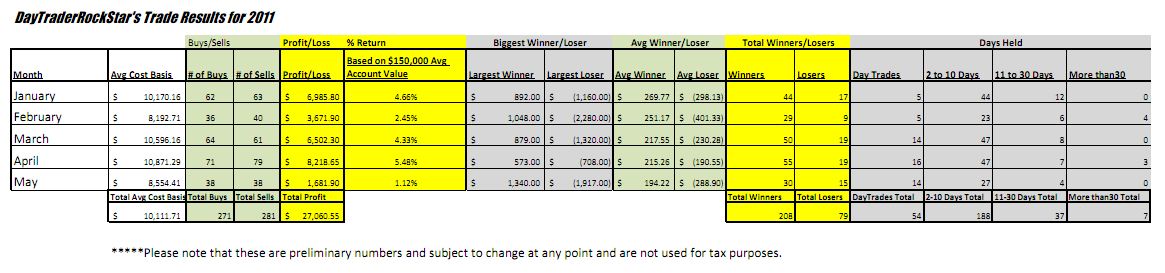
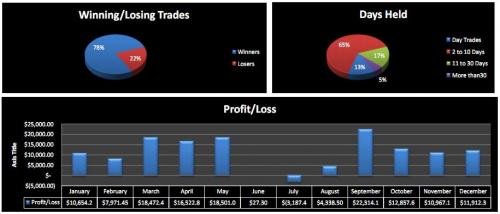
The following chart below breaks down my 2010 monthly performance. May was inspiring because I was able to feel some of the uneasiness in the market and liquidated most of my positions before the Flash Crash. I know a lot of members remember that day and followed suit and are probably around today because of it. But that turned out to be one of the best opportunities in the market. So you can see the major pull backs in 2010 were profitable. But as a trader in the spotlight you're only as good as your last trade. And the markets are filled with unexpected pitfalls (political, environmental, and economical). We are seeing them all this year.
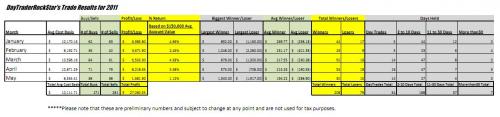
And below is Year to Date through May 2011
http://www.daytradingradio.com/pages/dtrportfolio
Trading in this environment is fine, most traders like the volatility. But you need to have an air tight methodology. Remember the markets trade to their extreme levels. What do I mean by that? Well take for example fictional stock "ABC". ABC has been trading in a channel for 4 months between 23.00 and 36.00. "The" Trading Book will tell you this is bullish and it is consolidating before heading higher and to buy on the break out. You see the stock slowly squeeze closer to its break out point; human nature has programmed us to try to anticipate the move so 50% of our test traders initiate a position before the breakout. The stock triggers a few ticks above the channel high and another 20% chase the break out and take positions. What happens then is what is called a false break out. This happens more and more in today's market. And it preys on novice traders who buy on the extreme end of a move because in reality that is what this is. Same theory applies to the downside. Whenever you have a line defined as support and resistance "the market" knows that it is a feeding ground for stops. So what does this mean for me? I first want to take the risk off the table on each trade so ideally I don't want to buy a break out unless it is a big institutionally followed stock like PG, or IBM, ECT. But I also want to be very nimble and quick on taking profits. I want to slowly scale in when a stock has a pull back to a defined support area, but because I know this is an area of interest I need to understand this area could break down short term. The first scale in entry is very important for me. It needs to be small enough that you can give your trade some breathing room. The markets are a casino it's just the way it is. Tell me one thing you can count on in the markets these days. You can have a great fundamentally sound company raking in the cash yet it will get punished because an analyst thinks it's overvalued. Two days later another analyst comes out with a totally opposite call. I'll break it down a bit more...
This market is no longer an investors market but a trader's playground where fundamentals play less and less of a part. You might think the analogy between the markets and the casino is wrong but there is a single factor that links them both. To be successful in either you need to wait for the best hand available to bet (trade).
So the key understands your risk. When I take a position I want most of the risk out of the trade and in order for that to happen I need to be at the extreme end of its trading range. I also want to have a recognizable range or pattern that I can gauge this range off of and I want to have my indicators in an oversold position or crossing back into a positive position. I also need to be able to scale into a position so that just in case I am wrong I am not in a precarious situation and I will be able to ride the trade out. You never want to be out of bullets. Forget what you have learned reading trading books. Here's where I get the hate mail: beware of the 2% rule or any rule that defines an exact number for taking a loss 2%- 5% is ridiculous. I do believe in money management, but I believe more in scaling in when everyone else is getting taken out. But even that comes with its risks and again the books will tell you to never add to a losing position. But again the books were written by a few who were authors who read other trading books that were written by other authors that read trading books by some ball room dancer or retired baseball player. Don't take that last sentence too serious, I just wanted to lighten things up a bit. The key to my money management is not being over exposed in any one position period. And that's where there is a disconnect on the site. I take a position in FDX with an average price of 87.68 and it drops to 85. That's close to a 3% move downward, but only a loss of $-214.40 because I am scaling in (I have 80 shares). Now people see my entry and take a position of a few hundred shares. It moves down and they are sweating. I see it happen over and over. It makes me look bad because I am holding the stock and adding to it but they don't take into consideration the overall picture and the stress of the trade. Stress of the Trade is a big (huge) factor in my trading style. Here are some of the rules I "try" to adhere to:
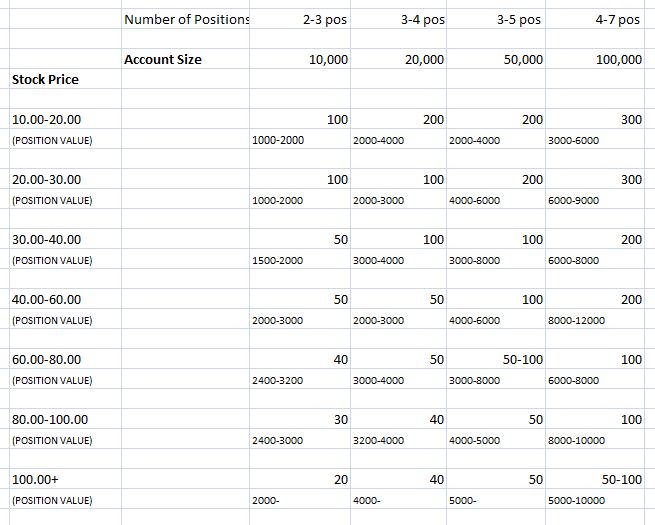
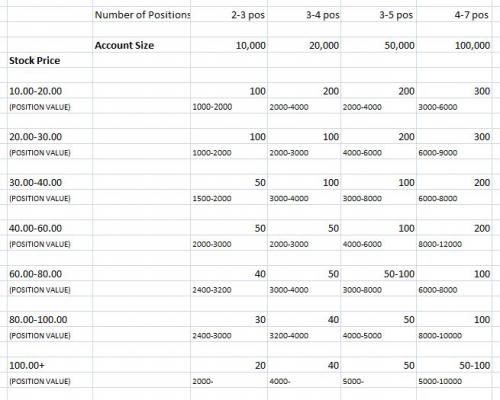
The first is position sizing. This chart gives you an idea on how I like to position myself. This is not a rule but a guide. This is not set in stone and I find myself stepping outside these boundaries on occasions mostly due to market conditions, but in some cases over lack of discipline.
* When entering a position for the first time in a pull back phase scale back on your entry size to half positions or even quarters.
* Personally, I keep a mental stop based on market conditions and size of each position "stress test". If I feel I have a high probability set up based on my supporting indicators I will let the stock have some wiggle room and add some time to the trade. The odds are in my favor that the market will consistently move back to its mean average and in this case I use the 20 EMA.
* I like to enter my stocks as they are extended away from the mean average. The mean average is calculated by taking the closing prices and dividing by 20 in this case. This basically gives you the 20 SMA. Exponential Moving Averages reduce the lag by applying more weight to recent prices relative to older prices. In order to reduce the lag in simple moving averages, technicians often use EMAs and so do I.
I pay attention to technical level on both the daily and 60 minute S&P cash to determine my risk.
The meat of the methodology is called "High probability Set Ups"
This is determined by a set of 5 indicators
1. Price on or near a confirmed trend line
2. Price on or near a moving average (20, 50,200 EMA)
3. Is there a recognizable pattern
1. Wedge
2. Channel
3. Inverted Head and Shoulders
4. Trend Line Breakout Retracement
5. Positive Stochastic Divergence
6. Double Bottom
4. Previous Short term resistance or support
5. Reversal candle Sticks
Now this is just a review as I discuss this each day on the show but here is a webinar I did that goes into more detail http://www.youtube.com/watch?v=UqHfWJ0zazM
One last key ingredient is market sentiment.
My method works on lining up the best scenario for a bounce in a trending market taking quality stocks as they retrace or bounce. In a confirmed bear market you would want to take the opposite side of the trade, just reverse the 5 indicators to
1. Upward Channels lines (Upper Trend Lines)
2. Trading up to a Moving Average
3. Recognizable Patterns
1. Rising Wedges
2. Channels
3. Head and Shoulders
4. Negative Stochastic Divergences
5. Double Tops
I want to talk more about the future of the site and look forward to the next chapter. You probably know by now I have been working on the next version of Daytradingradio.com and I couldn't be more excited looking back at the evolution of the site. We grew from a few members to one of, if not the largest, live online stock market shows today. The show is viewed and listened to all over the world. I always had an interest in broadcasting and as a hobby ran my own clandestine pirate radio station in NY. I moved to Florida again when my son was born, and was forced to shut down the pirate radio station due to stricter penalties in FL compared to NY. But because I was a trader and sitting in front of the computer all day I started researching how to stream audio on the internet. I thought it would be great to continue to broadcast down in Florida while I traded. I started out with a couple corny You Tube videos and built a web site to call home. Funny that DayTradingRadio.com was available looking back at it today. Over time the site grew and formed a following and I found myself dedicated to my new project. I never expected the site to grow as it did, but I just continued to dedicate my time to it. Soon traders started sending me donations for the work I was doing. I had more then one listener in the Middle East that would send me weekly donations and others asking me why I was doing this for free. Well eventually I realized the value of what I had here, but still didn't want to charge for something I was so passionate about. I decided to charge a nominal fee for my 10 for 100 Watch List and a members section and leave the general broadcast free. That's how it stands today 4 years later.
I wanted to share some of the stats with you for just this year compared to last year. The numbers in bold is from Jan 01-June 01, 2011 (6 months) and the previous lower number is Jan01 to June 01, 2010
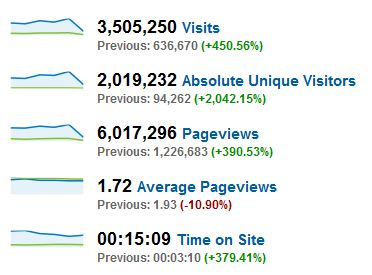
Now I am the last person to really dig into numbers, I just don't have time for that. But I wanted to share the above numbers with you as a bench mark: a time stamped in history as we move forward. One thing that stands above and beyond everything on this site is its members. There are real rockstar traders here. People who help new traders find there groove, teach them the ropes, answer questions take time out to give something back to the community. For that I am tremendously grateful for without those people this site would be a shadow of itself. For the members who use the chat room you feel a belonging there, something I haven't seen anywhere else. The Elite traders stand out and make themselves known. There are no attitudes, no boasting, no badmouthing, just team work.
When I started the site, it was out of passion for trading, wanting to share a journey and wanting to inspire people to take a chance on themselves. Sometimes I think we do that because that's what we want deep inside: to be inspired and to be motivated. I think the site has done that. But I also think I have taken it to a point where it has grown as much as it can with just me at the helm. There are too many great traders associated with this site to not bring them into the spotlight. So for the next version of DTR I will be recruiting the standout traders.
There will also be an:
Options Section (managed by and Options Specialist)
E-mini Section and other futures (managed by ES Specialist)
An elite trader box separating the trades and research of specialized traders
There will be a Morning Focus Watch List and Market Barometer
Possible Forex Section (Managed by a FX Specialist)
Another issue I will be addressing is the portfolio. When I started the site I really didn't know the direction and it was pretty much a daily account of my trading and weekly research the 10 for 1000 watch list. The watch list will stay as it is a tremendous value. I spend over 14 hours a week doing research 4 times a month and outline High probability Setups for the upcoming week. That time is worth 10 times the amount that member's pay which is $29.00/month or less.
A new account was just opened with Speedtrader and this is something that should have been done on the last revision as I currently trade my own accounts (165K) and (35K). My accounts include 2 IRA's and even when I bought a position for an IRA I disclosed it on the site and recorded it in the portfolio tracker. But there is no real separation on the site for different accounts and it has been a point of confusion and frustration. I want to solve that with the new site revisions. I started this site over four years ago with the intentions of documenting my research and trading style. I felt that the research and methodology was the real value behind it all and I still do. Being prepared for each day was key to my success and it will be for you. The most important thing I have learned is that each trader is different and we all have different personalities. We have been molded throughout our lives by our experiences. Some are more disciplined then others some have more patience. Some can handle stress and some can't. But when it comes to trading there has to be common denominator to keep us all making money. If we all started with equal capital it would be easy, but that's not the case and this is were problems can happen. A trader well capitalized can flow with the market waves easier then a trader that is trading with his or her rent money.
A couple final notes: The summer months tend to be choppy and sideways. We could be on the verge or a bigger pullback, but I am not convinced of that yet. But I do know that June and July have been historically slow months for me. So where do we stand? Well the market has given us a quick 2 week pull back. But the negativity in the markets is at an extreme level and the financial sector (The Banks) are the key to this market going up. If there is any good news on the horizon this will be a big positive for the markets. Until then sideways chop at the best. If there is any hint of more bad news, then I will do what I did last May and take a lot off the table and do more scalping with shorter time frame trades.
My realized gains from Jan 2011 through May 2011 are currently $27,057. If I close out most of my positions this week I would take an estimated loss of $11,000-$13,000. I would not sell anything in IRA's at this point as I firmly believe markets will make new highs later this year. But this scenario hasn't played out yet.
On DTR every burp, trade, fart, loss and gain is recorded and available for public viewing real time, this is something I always have done. There will always be people questioning my trading style, saying that I hold too many positions and in some cases don't take all the trades. This usually comes from people who traded above there means and blew there account up. I am a small fish nibbling away at the markets. There are traders on the site that take 1 position as big as both of my accounts. If you see me start trading over my means then start asking questions. Until then start a site dedicate 10 hours a day and 14 hours a weekend educating traders, also put out 444 videos, grandfather all the original members in at there expensive rate of 14.99 a month or 24.99 a month. Remember, the advice I give on DTR is for guidance only. Traders are responsible for their own trades.
Back to the Rockstar Traders, Dac and I have been monitoring traders in the room the last couple months and we are in the process of determining who will make the best fit for the site. This is where you the members come in. By all means share your thoughts with me let me know who you would like to see on the site in the spotlight. Email me at DTRS@daytradingradio.com. This will be a major change for DTR but I think we are ready for it.
I think I touched on most everything I wanted to this weekend. This site is nothing without its members and team there are so many people to thank along this journey. The problem is I would hate to leave one person out. So if you dedicated your time and energy to making this site what it is today I thank you and better yet you will not be forgotten as the site grows.
PS I need to Thank RPM this guy is the backbone to the site, and deserves to be recognized for that!!!!
and Mrland for his constant dedication to bringing me the news on his own time
DayTraderRockStar
|